A Letter to Tamil Nadu’s Political Generation
On the morning of May 4, 2026, Tamil Nadu woke up to something it had never experienced in seventy years of electoral democracy: a genuinely open question. For the first time in its post-independence history, the state had returned a hung assembly. No party had won a majority. No familiar coalition had swept the floor. The seemingly eternal duopoly between the DMK and the AIADMK had been punctured, not by ideology, not by a policy agenda, but by a 51-year-old former film star who had never held elected office. 108 seats. That is what Tamilaga Vetri Kazhagam (TVK) won on April 23, 2026. It is an extraordinary number for a party that did not exist four years ago, that has never administered so much as a municipal ward, that fielded 234 candidates of whom the overwhelming majority had never contested an election in their lives. By every conventional measure of political science, this should not have happened. And yet it did.
I write this not as someone who mourns TVK’s victory. I write this as someone who believes in Tamil Nadu deeply enough to refuse to let this moment become a celebration without scrutiny. Because the real danger is not that TVK won. The real danger is what happens if we mistake winning for governing if a generation that fought hard to cast its first vote goes home, exhales, and waits for the cinema to become reality. This is a letter to that generation and many more. It is written with love and with urgency.
I. The Inheritance: What did the last 70 years build?
To understand why Tamil Nadu voted the way it did, you must first understand what it was voting against and more uncomfortably, what it was voting away from.
The Dravidian movement is one of modern India’s most consequential political experiments. What began as Periyar’s Self-Respect Movement in 1925, a civilisational argument against caste hierarchy and Brahminical order became, through C.N. Annadurai’s electoral genius, the governing philosophy of a state. When the DMK swept the 1967 elections and ended decades of Congress dominance, it did not just change the government. It changed what Tamil politics meant. Social reform, rational thought, Tamil identity, and the language of equality entered the grammar of governance itself and continues to.
The welfare state that followed built across alternating DMK and AIADMK governments is not mythology. It is measurable.
| Policy / Scheme | Party (Year) | Indicator Improved & Measurable Impact |
| Nutritious-Noon Meal Scheme | AIADMK – MGR (1982) | Primary school dropout rate fell from ~40% to under 1%; child nutrition and enrolment ↑ across rural TN. |
| Cradle Baby Scheme | AIADMK- Jayalalithaa (1992) | Female infanticide near-eliminated; sex ratio improved from 948 to 996 per 1,000 males (2011 Census). |
| Girl Child Protection Scheme (GCPS) | AIADMK (1992) | Financial incentives reduced anti-girl bias in rural districts; preceded and informed national policy design. |
| 2-Rupee Rice Scheme | DMK Karunanidhi (2006) | Subsidized rice at ₹2/kg for BPL families 7 years ahead of the national Food Security Act (2013). |
| Kalaignar Medical Insurance Scheme | DMK (2009) | Cashless treatment for 1.5 crore BPL families up to ₹1 lakh a decade before Ayushman Bharat. |
| Free Laptop Scheme | DMK Karunanidhi (2011) | 15 lakh laptops to government school students; TN consistently ranks among top states in digital literacy. |
| Amma Canteen | AIADMK Jayalalithaa (2013) | Subsidised meals (idli ₹1, rice meal ₹5) in 400+ canteens; caloric poverty reduced among urban daily wage workers. |
| CMCHIS | AIADMK (2012, expanded) | ₹5 lakh/family health cover; TN IMR fell to 13 per 1,000 live births less than half the national average of ~28. |
| School Breakfast Programme | DMK Stalin (2022) | Free breakfast for Classes 1–12 in government schools; TN school retention rates among highest in India. |
| Magalir Urimai Thogai | DMK /Stalin (2023) | ₹1,000/month direct cash transfer to 1.06 crore women heads of household in first phase alone. |
This was not an accident. It was decades of compounding welfare investment, regardless of which Dravidian flag flew over Fort St. George.
The DMK government that came to power in 2021 inherited this legacy and, by the numbers, extended it credibly.
Tamil Nadu’s GSDP grew at 11.19% in FY2025 and 10.83% in FY2026, more than double the national average. The state inked 1,179 investment MoUs between 2021 and 2026, representing ₹12.37 lakh crore in investment potential and 36.52 lakh projected jobs, with a conversion rate of 73.53%. Exports doubled in a year, touching $52.07 billion. Electronics exports grew 36% over five years. By every macro-economic indicator available, Tamil Nadu under M.K. Stalin was the best-performing large state economy in the country.
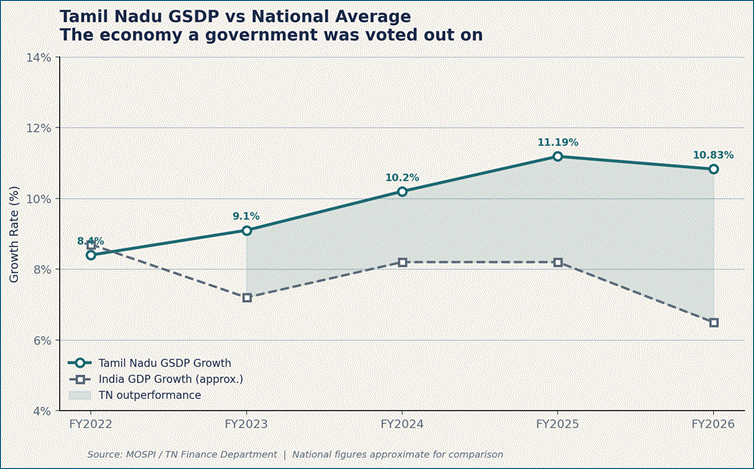
The state that ousted one of its best-performing governments in recent memory did so because data does not vote. People do.
And people vote on what they feel, what they fear, and what story they are told about themselves.
II. The shield against saffron: What DMK’s dissent meant
There is a second dimension to DMK’s five years in power that has been almost entirely lost in the noise of the verdict its role as Tamil Nadu’s most articulate and combative voice against an increasingly centralising Union government.
The issues were not abstract.
- One Nation One Election: a proposal that would effectively subordinate state electoral cycles to national ones, eroding federal autonomy.
- The National Education Policy’s three-language formula, which Tamil Nadu perceived, correctly, as a vector for Hindi imposition through the backdoor.
- Delimitation: the spectre of a parliamentary seat reallocation that would systematically reward states with higher population growth (predominantly Hindi speaking) at the expense of states like Tamil Nadu that had invested in family planning and literacy for decades.
The DMK fought all of these, loudly, in Parliament and in the courts. It was not performance. It was a genuine constitutional battle over what kind of federal republic India intends to be. The 2024 Lok Sabha election was, in this light, a thunderclap. The INDIA alliance, with DMK as its Tamil Nadu anchor, swept all 39 parliamentary constituencies in the state plus Puducherry a clean 40/40 while the NDA was decimated. Tamil Nadu sent a message to Delhi that was impossible to misread. Two years later, those same voters sent a different message to Chennai.
The question is this: if Tamil Nadu could hold both of these positions simultaneously, what were they really saying? The answer, I believe, is that Tamil Nadu voted for DMK to represent it nationally and voted it out locally. The state trusted the party to fight Delhi. It did not trust the party to run its streets.
III. The Disruption:
Tamilaga Vettri Kazhagam was registered as a political party in February 2024. It contested its first assembly election in April 2026. In between, it went from a press conference to the single largest party in the Tamil Nadu Legislative Assembly. This is, by any measure, one of the most extraordinary political debuts in Indian electoral history.
But here is what the celebration must not obscure: TVK did not emerge from a vacuum. Of the 108 legislators walking into the assembly, a significant number are not political newcomers they are political recyclers. Camp migrations are a routine feature of Tamil political life politicians read the wind and move. What is not routine is a mass exodus of experienced, incumbent-era politicians into a party contesting its very first election. That deserves more scrutiny than it has received. It raises a question that TVK’s supporters must sit with: if these individuals left the DMK and AIADMK because of corruption and dysfunction, why did those parties field them for years?
TVK’s ideology what Vijay described at the party’s founding conference as “secular social justice, secularism, egalitarianism, and a two-language policy” sounds structurally identical to the Dravidian platform it claims to supersede. It is not a new ideology. It is the same furniture rearranged in a newer house, with a much younger host and a dramatically better social media presence.
You cannot run purity politics with a cabinet full of people you accused of being impure.
This is not a cynical observation. It is a structural one. Tamil Nadu’s political ecosystem has, for decades, been built on a network of relationships, caste loyalties, local strongmen, and patronage chains. TVK absorbed large numbers of people from that very network. The question of whether it can govern differently from inside the same machinery is one that TVK’s supporters the ones who voted for a clean break should be asking loudly, not later, but now.
IV. The Voter:
Three distinct voter cohorts drove TVK’s historic result, and understanding each of them is essential to understanding what was actually mandated.
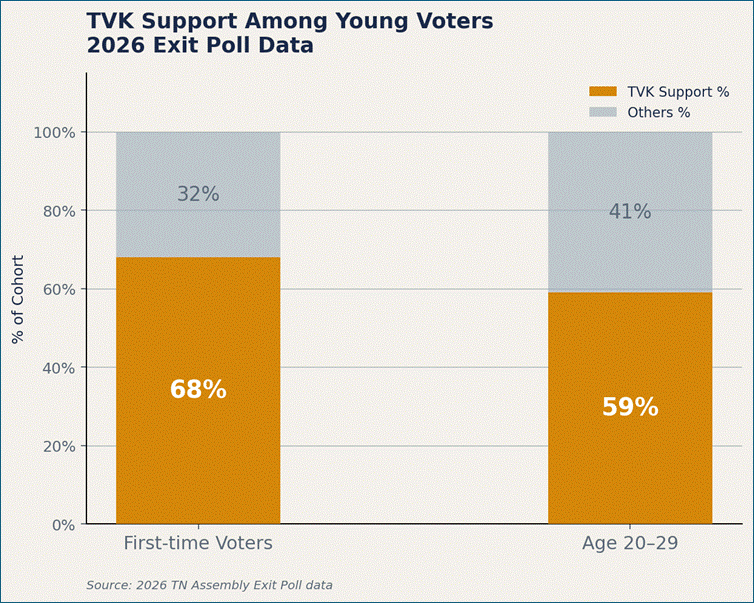
- The first cohort is the most discussed: Gen-Z and first-time voters. Exit poll data from the 2026 election shows that 68% of first-time voters and 59% of voters aged 20 to 29 expressed support for TVK. This is not a marginal skew. It is a generational statement. These are voters raised on a diet of Vijay films where power is always corrupt, the outsider is always pure, and the hero always wins a cinematic political education repeated across two decades. To pretend that this cultural conditioning played no role in how a generation imagined governance would be as naive as the belief itself.
- The second cohort is economically significant but politically under-theorised: the NRI and Tamil diaspora support. For Tamizhans abroad, Tamil political identity has long been filtered through the DMK-AIADMK binary inherited from their parents. The enthusiasm on diaspora social media channels for TVK was not merely fan-following. It was, for many, a first genuine stake in Tamil Nadu’s political future which makes it worth noting that this stake carries no personal consequence. There is something telling about the ferocity with which people opine on a place they chose to leave. It is a displaced identity politics, loud and costless, mistaken for civic participation.
- The third cohort is the most paradoxical: economically weaker sections who have been direct beneficiaries of the welfare state that both the DMK and AIADMK built over decades and who voted against the architects of that welfare state. These are voters who have received free rations, free health coverage, subsidised electricity, and scheme-based support. They voted for TVK not despite this welfare legacy but, in a sense, because of it. The welfare state normalised the expectation of a government that delivers.
- Is the TVK voter caste agnostic?: TVK has publicly claimed to have broken caste politics. This claim deserves careful scrutiny rather than acceptance. TVK’s candidate distribution, viewed against caste geography, follows patterns not dissimilar to those of the DMK and AIADMK before it. The packaging is different. The underlying calculation is familiar. Breaking caste politics requires not just new candidates but new institutions and those take decades to build and unfortunately social media echo chambers do not cut it.
- The most under-analyzed cohort is Tamil women not young women shaped by digital media, but women across age groups, including those in their thirties, forties, and fifties, who voted for Vijay with a conviction that had little to do with Instagram reels or manifesto fine print. Vijay did not invent this dynamic. He reactivated it, with a newer face and a sharper promise. This essay would be dishonest if it folded that vote into the echo chamber critique or dismissed it as conditioning. It is the oldest and most consistent thread in Tamil electoral behaviour.
V. The Algorithm and the Echo Chamber: A Generation Misinformed
A two-minute video that explains why DMK is corrupt is optimised for your rage, not your understanding. A meme that reduces a complex governance failure to a punchline is not political education. It is political entertainment. And political entertainment, no matter how beautifully produced, is not the same as political knowledge.
A significant portion of TVK’s first-time voter base made their decision in an information environment that was structurally designed to amplify grievance, reduce complexity, and celebrate Vijay. Content creators who built large followings by linking Vijay’s film dialogues to political analysis, who drew equivalences between his on-screen heroism and his political potential, found massive audiences not because they were accurate but because they were affirming.
The content economy around TVK the WhatsApp forwards, the fan-made campaign videos, the reaction videos to Vijay’s speeches monetised political emotion at industrial scale. And a generation that is, in many ways, more digitally literate than any before it, proved just as susceptible to an echo chamber as its parents were to the cult of the cassette and the street corner speech.
The tragedy is not that they were wrong to want change. The tragedy is that many of them don’t yet know the difference between wanting change and understanding it.
VI. Why DMK lost: The structural and cultural autopsy
The DMK’s defeat demands honest analysis, not because it deserves sympathy, but because the reasons behind it will shape what happens next. The structural reason is historically consistent: Tamil Nadu has voted out the incumbent government in every election since 1984, with 2016 as the solitary partial exception. Anti-incumbency is baked into the state’s electoral DNA. No matter what a government delivers, the pendulum swings. This pattern alone accounts for a portion of DMK’s losses.
But the scale of this defeat with a sitting Chief Minister losing his own constituency, fifteen cabinet ministers defeated by first-time candidates with zero administrative experience requires more than structural explanation. The DMK had specific, avoidable failures that compounded into a verdict. My understanding:
- The dynastic question: For a party whose ideological roots lie in Periyar’s radical rejection of hereditary entitlement, the optics of a son being groomed to succeed a father who succeeded his own father were devastating. Seasoned party veterans who had served for decades were bypassed. The contradiction between the Dravidian meritocracy the party preached and the dynastic reality it practised was not lost on the electorate. The problem was compounded when ED investigations into the TASMAC scandal surfaced names reportedly linked to Udhayanidhi’s film business circle making the dynasty critique and the corruption critique the same story.
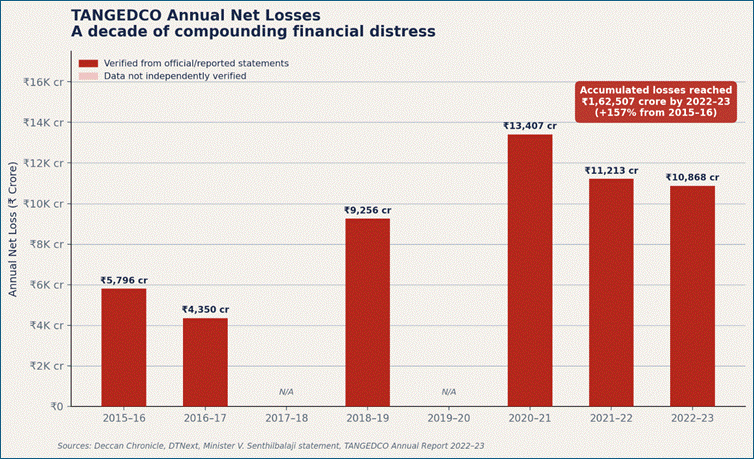
- TANGEDCO: The power cuts and transformer failures that Tamil Nadu households endured were not mere inconveniences they were the visible symptom of a fiscal emergency the DMK neither inherited cleanly nor resolved. TANGEDCO recorded ₹1.62 lakh crore in accumulated losses as of FY2023. Its debt grew 157% in seven years from ₹63,162 crore in 2015-16 to ₹1,62,507 crore in 2022-23. The DMK’s ideological resistance to any form of distribution reform or private participation in electricity delivery driven more by political calculation than economic evidence meant that a structural problem with known solutions remained deliberately unsolved.
- Corruption: The opposition’s charge sheet against the DMK was long, but two scandals cut through: TASMAC and sand mining. ED raids on Tamil Nadu State Marketing Corporation officials uncovered irregularities estimated at ₹1,000 crore or more in the state liquor monopoly a body that, by its nature, is both politically sensitive and financially opaque. That names reportedly connected to the ruling family’s business network emerged in the investigation. transformed it from a departmental scandal into a dynastic one. Separately, illegal sand mining valued at an estimated ₹4,700 crore over three years was documented through opposition filings and investigative reporting. The DMK dismissed this to be political theatrics as expected.
- Women’s safety and the POCSO data: Tamil Nadu’s overall crime-against-women rate remains below the national average that is factually accurate and should not be obscured. But within that picture, POCSO Act cases (crimes against children) rose from 4,968 registered cases in 2022 to 6,969 in 2024, a 40% increase in two years. This specific figure is from NCRB data.
- First-time voter: Of all its failures, this one is the most damaging. The first-time voter was not abandoned for lack of trying as the he DMK’s digital infrastructure is formidable, its IT wing coordinated, its response machinery among the sharpest in Indian state politics. DMK’s digital voice, however competent, was still the voice of an institution and that institution carried the accumulated weight of everything this generation had grown up quietly doubting. The failure wasn’t reach. It was resonance.
TVK didn’t win the new voter with a better strategy. It won with a different origin story one that began in fan clubs and film halls long before it became a party. They voted on instinct, on hope, on the simple feeling that something needed to change. That instinct is not wrong. But it is precisely because they deserve more than instinct that I have laid out this account not to diminish their choice, but to arm what comes next.
VII. The glimmer if we choose to see it
I have spent the length of this essay in the difficult terrain of scrutiny. But this is where the argument must turn, because the case for hope in Tamil Nadu’s 2026 verdict is real, and it would be dishonest not to make it.
- 85.1% voter turnout in a moment of global democratic fatigue, Tamil Nadu produced an election where nearly nine in ten eligible voters showed up.. That is, in fact, remarkable. Vijay’s entry into politics, whatever one thinks of his readiness to govern, made politics feel accessible and urgent to a generation that had been told it did not belong in that conversation. Participation is the precondition of accountability. A generation that turned out at 85% is a generation that is paying attention. The only question that matters now is whether that attention will be sustained beyond the celebration.
- There are TVK legislators who are genuinely promising. First-time MLAs who came through civil society, through professional backgrounds, through activism rather than through the patronage ladder. They exist. They are a minority within the 108, but they are real. Democracy has always been improved by individuals who take their mandate seriously within imperfect systems. Tamil Nadu has produced such people across party lines before. TVK may produce too.
- The DMK, without meaningful opposition in the assembly, had grown comfortable. Comfort in governance, as in life, is the enemy of improvement. The verdict of 2026, whatever its imperfections, restores consequence to governance. The DMK will now have to rebuild honestly or cease to be relevant. The AIADMK will have to resolve its identity or fragment. TVK will have to govern or be exposed. Accountability has been reintroduced into a system that was running low on it.
VIII. The Work That Begins Now
To the person who voted for TVK because they believed in something better: you were not wrong to want change. Tamil Nadu needed disruption. The duopoly needed breaking. The complacency needed a shock. You gave it one. That impulse was correct. But democracy is not a film. A debutant cabinet, however well-intentioned, does not walk into Fort St. George knowing how to do any of this. The learning curve is real. The institutional memory gap is real. And the cost of getting it wrong falls not on Vijay or his ministers but on the people of Tamil Nadu who need the state to simply function.
You have tools no previous generation of Tamil voters had. You can track budget allocations in real time. You can read assembly question papers and government orders. You can file RTI requests, organise accountability meetings, build the kind of sustained civic pressure that forces even reluctant governments to perform. The same algorithms that amplified your enthusiasm for TVK can amplify TVK’s failures when they occur and they will occur, because all governments fail somewhere, and the failures of a first-time government in a hung assembly will be neither small nor infrequent.
The media ecosystem that built Vijay’s political persona will now attempt to sustain it. Content creators who made careers from TVK enthusiasm will face a choice: Evolve into accountability journalism or reformat the fan club under new branding. Most will choose the latter. It will be the more popular choice. Knowing the difference between a creator who is holding this government to account and one who is simply protecting their audience is now part of what it means to be a politically conscious Tamil Nadu voter. Because the vote was the easy part anyone can vote. What comes after is harder, less visible, less shareable, and more consequential than anything that happened on counting day. Tamil Nadu has always known how to produce movements. The harder question the one this generation must now answer is whether it knows how to sustain one.


 Haniya Amjad
Leave a comment